
Switched Attenuator Unit (a HomeBrew Project by our member JAYAR)
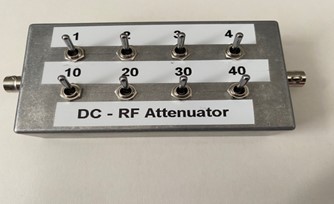
This article details the construction of a balanced switched attenuator with 50 ohm input and output.
Using only 8 double-pole double-throw (DPDT) switches an attenuation range of -1dB to -110dB in 1dB steps is provided. Attenuation switched values are 1, 2, 3, 4, 10, 20, 30 and 40. Since dB values are additive, 69dB, for example, can be selected by operation of switches 2, 3, 4, 20 and 40
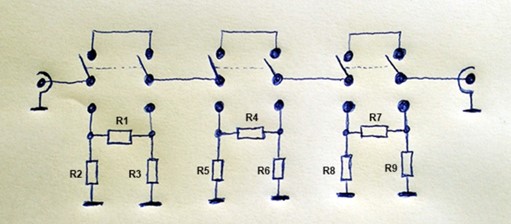
With the switches in the upper position the signal circuit is directly routed between input and output. If any switch is set to the lower position, the relevant 3-resistor pi type attenuator is switched into circuit. With each of the vertical resistors in any pi stage set equal, the attenuator input and output impedances are identical.

The application https://chemandy.com/calculators/matching-pi-attenuator-calculator.htm was used to determine theoretical resistance values. These values are identified in the attached tabulation as
"Theoretical Values" Note that in this tabulation R1 and R3 form the legs of the pi circuit.

The theoretical values are not standard E12 values but the application qsl.net/in3otd/parallr.html
provides an excellent tool to calculate both series and parallel resistors to achieve good 'near miss' values. Since it was neater to combine resistors in parallel within the build, the best fit parallel configurations were chosen. These are shown in the E12 Practical Values columns in the tabulation. For example, in the 1dB row a desired vale of 869.548ohms was required. From the application it was determined that 1000ohms in parallel with 6800ohms produces a value of 871.795ohms which is reasonably close to the desired value.
To determine the effect of the 'near miss' values on attenuation and impedance, a rerun of the Chemandy application produced the results in the Build Results columns of the tabulation.
To further minimise errors, 1% resistors were used through-out the build.
The whole was built into a diecast enclosure 11 x 9 x 3cms with BNC female through-chassis connectors used as the I/O terminations.